 Guide
GuideWhat Is a Meeple? Board Game Terms, Explained
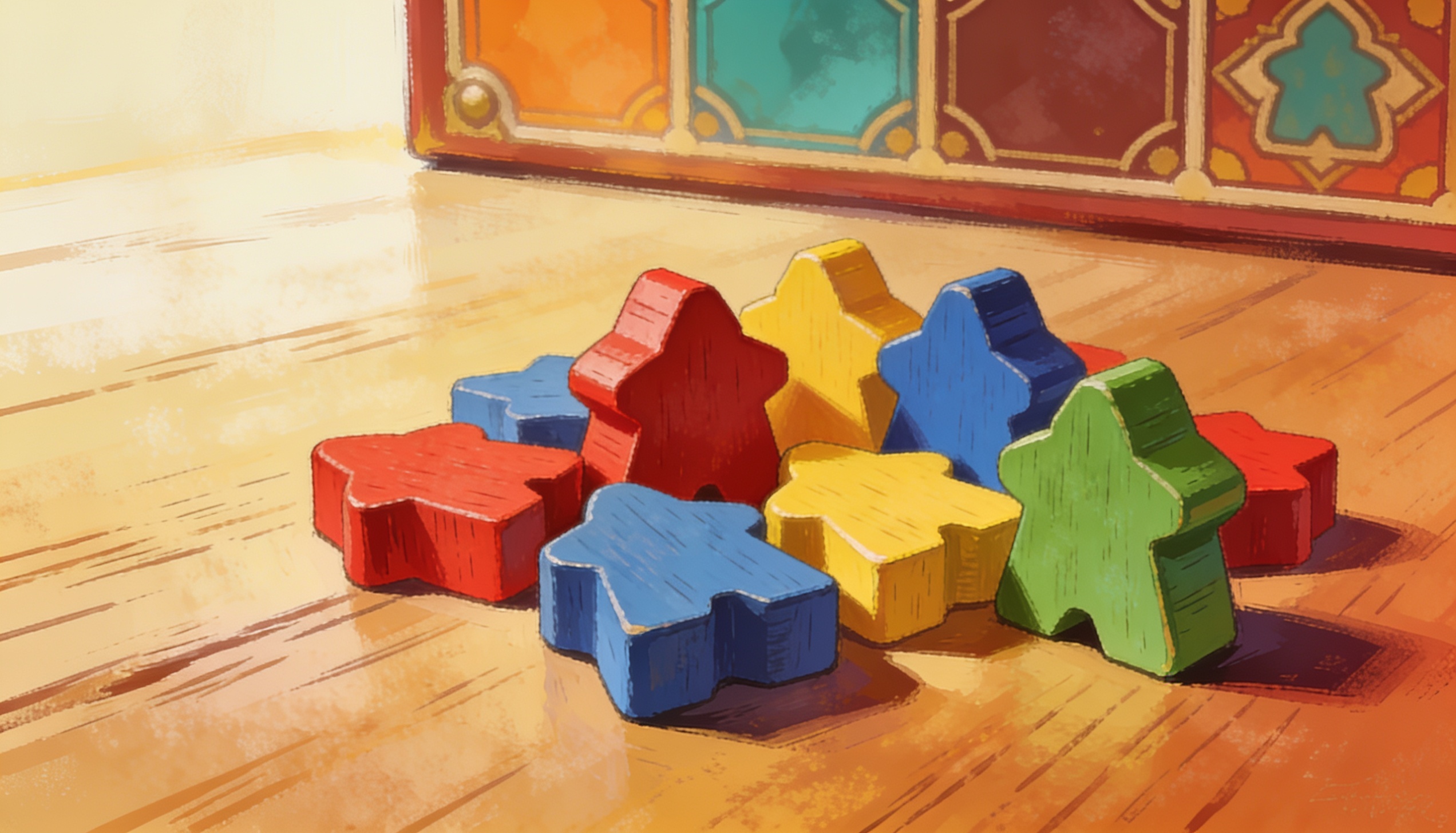
A meeple is a small wooden (or plastic) game piece shaped like a person, and it's the most famous bit of jargon in the whole hobby. The word is a smush of "my people," it got its start in the tile game Carcassonne, and these days you'll find meeples standing in for workers, settlers, scientists, and basically any little human you push around a board.
But meeple is just the gateway term. Walk into a game shop or scroll a board game forum and you'll hit a wall of words like "worker placement," "deck-building," and "AP." None of it is hard once someone explains it without the smugness. So that's what this is: a friendly glossary of the board game terms you'll actually run into, with real games as examples so the words stick.
Meeples and the Bits in the Box
Let's start with the pieces. A meeple is that classic person-shaped token, usually a single bright color, and it represents you or your workers on the board. Carcassonne made it famous, and now games like Agricola and Stone Age are full of them. You'll also hear spin-off names: a cow piece is sometimes a "cowple," a horse a "horse-meeple," and people will argue about this forever.
The rest of the bits have names too. "Components" is the catch-all for everything in the box: cards, tokens, dice, and boards. "Bits" or "chits" usually means the small cardboard punch-out tokens. "Standees" are flat cardboard figures that slot into plastic bases. And "minis" are the detailed plastic miniatures you get in bigger games like Scythe or anything in the Marvel Champions and Star Wars world.
One more: "first-party insert" or just "insert" is the molded tray that holds your components. Good ones save your table setup. Bad ones make you buy a third-party organizer off Etsy.
Where the Word Meeple Came From, and How to Say It
Meeple has a real origin story, and it's a good one. Back around 2000, a player named Alison Hansel was talking about the little wooden figures in Carcassonne and smushed "my people" into "meeple." The word spread through the hobby by pure word of mouth, with no company behind it, and now it's the standard term for any person-shaped piece in any game. Carcassonne didn't invent the shape, but it's the reason we all have a name for it.
You say it "MEE-pul," rhyming with "people," which fits given where it came from. One meeple, two meeples, done. The classic shape is that rounded head on a wide little body with no separate arms or legs, and there's a practical reason for it: it's simple to cut from a sheet of wood, easy to pick up, and reads as a person from across the table at a glance. That silhouette got so recognizable that it now stands in for the whole hobby, printed on shirts, mugs, and shop signs.
In the rules of a game, a meeple almost always represents you or your workers. You place it, move it, or claim a space with it, and where it sits usually decides what you're allowed to do that turn. Carcassonne uses them to claim roads and cities, Agricola and Stone Age treat them as family members and laborers, and dozens of worker-placement games use them as the little crew you send out each round. Once the word clicks, you start spotting meeples everywhere.
How You Actually Take Your Turn
Most jargon describes a game's core mechanism, which is just the engine that drives what you do on your turn. "Worker placement" is the big one. You have a few meeples, and you place them on action spaces to do things like gather wood or take coins. Once a space is taken, it's often blocked for everyone else, so you're racing for the good spots. Lords of Waterdeep and Agricola are the textbook examples.
"Deck-building" is another you'll hear constantly. You start with a weak deck of cards and slowly buy better ones, shaping your hand over the game. Dominion invented the genre and it's still a great place to learn it. "Drafting" means picking from a shared pool and passing the rest along, like in 7 Wonders, where a stack of cards moves around the table and you grab one each pass.
You'll also bump into "engine-building," which is when your turns start small but snowball as your pieces combo together. By the end you're doing five things off one action and grinning about it. Wingspan is a friendly entry point here.
The Big Style Labels (and the Snobbery Around Them)
Two words split the hobby: "Eurogame" and "Ameritrash." A Euro leans on strategy, low luck, and indirect competition, where you rarely attack other players directly and the theme sits lightly on top. Think Terraforming Mars or Castles of Burgundy. The name comes from the German design tradition that popularized this style.
"Ameritrash" sounds like an insult and started as one, but plenty of fans wear it proudly. These games lean into theme, big dramatic swings, dice, direct conflict, and player elimination. Twilight Imperium and most dungeon crawlers fit the mold. Neither style is better. They just want different things from a night at the table.
You'll also see "abstract" (little or no theme, pure decisions, like Azul or chess), "party game" (light, social, plays a crowd, like Codenames), and "4X" (eXplore, eXpand, eXploit, eXterminate, the big empire-building epics). Knowing which bucket a game sits in tells you most of what you need before you even read the box.
Words People Throw Around at the Table
Some terms are less about design and more about what happens while you play. "AP," or analysis paralysis, is when a player freezes up overthinking a move while everyone else stares at the ceiling. It's not a flaw in the person, usually it's a sign the game gives you too many options at once.
"Downtime" is the stretch between your turns where you've got nothing to do. Games with lots of downtime can drag with bigger groups. "Take-that" describes mechanics built to mess with opponents directly, like stealing a card or blocking a plan, and it's love-it-or-hate-it. "Kingmaking" is when a player who can't win gets to decide who does, which can sour a close game.
A few more worth knowing: "AP" can also mean action points (how many things you can do on a turn, so context matters). "Runaway leader" is a player so far ahead the ending feels decided early. And "table presence" is the cozy way to say a game looks fantastic spread out, which, let's be honest, is half of why we buy them.
A meeple is just a person-shaped game piece, and the rest of board game jargon is equally simple once someone explains it without the attitude.
Common questions
Where did the word meeple come from?
It's a blend of "my people," coined by a player describing the little wooden figures in Carcassonne back in the early 2000s. The name stuck, and now meeple is the standard term for any person-shaped game piece across the whole hobby.
What's the difference between a Eurogame and an Ameritrash game?
Euros emphasize strategy, low luck, and indirect competition, with theme as light decoration (Terraforming Mars, Azul). Ameritrash games lean into theme, dice, direct conflict, and dramatic swings (Twilight Imperium). One isn't better than the other, they just deliver a different kind of fun.
What does AP mean in board games?
It usually means analysis paralysis, when a player overthinks a turn and slows everyone down. Confusingly, AP can also stand for action points, the number of things you're allowed to do on your turn. You'll know which one from context.
How do you pronounce meeple, and what's the plural?
It's said "MEE-pul," to rhyme with "people," which is fitting since the word is a mash-up of "my people." The plural is just "meeples." However you spell it, it means the same thing: a small person-shaped game piece.