Carcassonne vs Azul: Which Should You Buy?
If you're shopping for your first really good two-player game, you've probably had Carcassonne and Azul open in side-by-side tabs. I get it. They sit in almost exactly the same spot on paper: both play in 30-45 minutes, both land in that light-medium sweet spot where a seven or eight-year-old can join in but the adults still have plenty to chew on, and both are lovely to look at on the table. They're also both games I'd happily hand to someone who swears they don't do board games.
Here's the difference that actually decides it, though. Carcassonne is a builder. You're growing a shared medieval map together, and the cunning is soft and low-conflict, the kind that pairs well with a glass of wine. Azul is a duel. It's pure pattern and timing, and half of what you're doing is deciding what you're willing to hand your opponent. Cozy versus quietly cruel. Once you know which of those sounds like your table, you basically have your answer.
/pic8621446.jpg)
Carcassonne
2000 · Klaus-Jürgen Wrede
A quiet, puzzly tile-layer that grows a whole little world on the table in front of you.
Affiliate link — we may earn a commission at no extra cost to you.
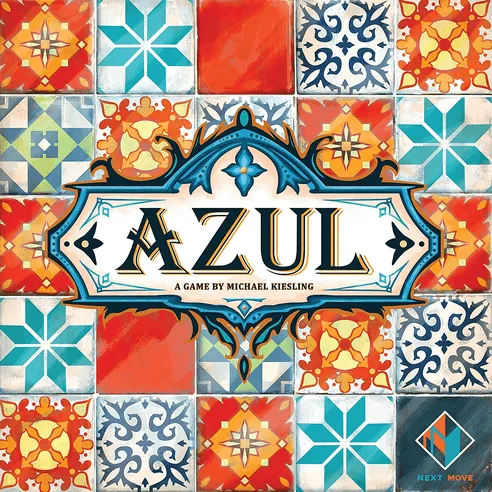
Azul
2017 · Michael Kiesling
The chunky tiles feel like candy, and the game under them is a clean little knife fight.
Affiliate link — we may earn a commission at no extra cost to you.
Carcassonne
- Watching the map grow each turn is quietly satisfying
- Simple enough for a seven-year-old, sharp enough for the adults
- Quick to set up and quick to put away
- A bad run of tiles can pinch your plans
- The scoring takes a game or two before it fully clicks
Azul
- The resin tiles are so satisfying you'll fidget with them
- You can teach it in two minutes and the depth shows up right away
- It's fantastic at two players
- There's basically no theme, it's pure pattern and timing
- A runaway leader at four players can be hard to catch
Carcassonne and Azul both sit in our Family list. See the full Family ranking to find where each one lands and what else is worth a spot on your shelf.
How they actually play
Carcassonne is one tile at a time. You draw a tile, it's a stretch of road or a city wall or a field, and you place it so the map grows. Then you decide the real question: do you drop one of your little wooden meeples to claim what you just built? Claim a city too early and someone can connect to it and help themselves to your points. Wait too long and they plant their flag first. Slowly this medieval countryside sprawls across the table, half yours and half theirs, and watching it grow is quietly satisfying in a way very few games manage. There's no big dramatic swing and no moment the whole table gasps. That's not a flaw, it's the whole personality.
Azul feels completely different the second you start. You're drafting sets of gorgeous resin tiles from shared piles (tiles so satisfying you'll fidget with them between turns) and laying them onto your board for points. The catch is that every tile you take leaves the rest for everyone else, so you're constantly weighing what you want against what you're giving away. At two players especially, it turns slow and a little vicious, a game of denial where you'll grab tiles you don't even want just to keep them away from the person across the table. Where Carcassonne builds something together, Azul is two tidy boards and a lot of polite scheming between them.
Complexity and learning curve
Neither one will scare anybody off, but Azul is the faster teach. You can explain it in about two minutes, and the depth shows up right away, so a first game already feels like a real game. There's no theme to explain because there's basically no theme at all. It's shapes and timing, full stop, which is exactly why people who claim they don't like board games have usually forgotten they said it by round two.
Carcassonne's rules are just as simple (it's rated for ages 7 and up, and it really is simple enough for a seven-year-old while staying sharp enough for the adults), but the scoring takes a game or two before it fully clicks. So expect the first play to be a friendly practice round. After that, both games get out of the way and let you just play.
Replayability and table presence
Carcassonne stretches further on player count, handling 2-5 to Azul's 2-4, and it's quick to set up and quick to put away, which matters more than people admit for how often a game actually hits the table. Its main wobble is luck: a bad run of tiles can pinch your plans, and you have to be okay shrugging that off. But as a thoughtful, good-looking game for two people on a slow night, it's an easy one to keep coming back to.
Azul is the stronger repeat player at exactly two. It's fantastic head to head, the kind of game that's easy to return to night after night, and it earns a permanent spot by the front door as a quick, good-looking brain-tickler. Its weak point is the top of its count: a runaway leader at four players can be hard to catch. And if you need a story to stay interested, Azul won't give you one, while Carcassonne at least hands you a little medieval world to point at.
Both of these belong on the short list, so this comes down to your table, not the games. If you mostly play as a couple and you enjoy a crisp, slightly mean puzzle where every pick matters, buy Azul. It's the better pure two-player duel, the faster teach, and the one I'd hand to a skeptic first. If you want something gentler, want room for five, or want the whole family building the same little countryside on a Sunday afternoon, Carcassonne is the cozier buy and the one that suits slow, contented evenings. Honestly, most shelves end up with both eventually, and neither one gathers dust.
Buy Azul for the tidy, mean two-player duel, and Carcassonne for the cozy map-building evening that fits the whole family.