Catan vs Ticket to Ride: Which Should You Buy?
Ask anyone for the first game to build a collection around and you will hear these two names more than any others. They are the gateway classics, the games most likely to already be half-known by someone's family, and the ones that have pulled more reluctant people to a table than almost anything else on the shelf. If you are buying your very first modern board game, you are almost certainly choosing between these.
They share that mission of turning a non-gamer into someone asking for one more round, but they get there very differently. Catan is about settling an island, pulling resources off dice rolls, and trading like a tiny merchant. Ticket to Ride is about quietly collecting cards and claiming train routes across a map. One is loud and a little chaotic; the other is clean and almost foolproof. Here is how I would steer you.
/pic9156909.png)
Catan
1995 · Klaus Teuber
Not the deepest thing on the shelf anymore, but the trading still makes magic happen.
Affiliate link — we may earn a commission at no extra cost to you.
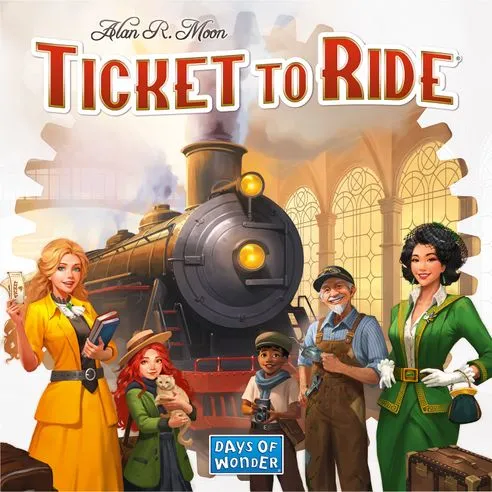
Ticket to Ride
2004 · Alan R. Moon
About as close to a perfect family game as it gets. Three minutes to teach, room for everyone.
Affiliate link — we may earn a commission at no extra cost to you.
Catan
- The trading turns a quiet table into a loud one fast
- No two games lay out the same way
- Most people's families already half-know it, so it's easy to start
- A cold run of dice can leave you starved while others sprint ahead
- Getting boxed out of room to expand feels rotten
Ticket to Ride
- You can teach it in well under five minutes
- Kids and grandparents keep up at the same table
- Tense without ever turning nasty
- Veterans will eventually want something with more bite
- Late-game route blocking can sting a younger player
Catan and Ticket to Ride both sit in our Family list. See the full Family ranking to find where each one lands and what else is worth a spot on your shelf.
How they actually play
Catan lives and dies on its trading. You are settling an island, pulling resources off dice rolls, and bartering like a little merchant to build your roads and towns. The table comes alive the second everyone starts swapping wood for sheep and accusing each other of robbery. That four-way trade falling apart at the last second is a specific kind of electricity newer games rarely recreate. The catch is the dice: a cold run can leave you collecting nothing while everyone else builds, and getting boxed out of room to expand feels genuinely rotten. It is not perfectly fair, and that is part of its character.
Ticket to Ride is far cleaner. You collect colored train cards and spend them to claim routes across a map, racing to connect the cities on your secret tickets. That is the whole thing, and it is plenty. What makes it sing is the long, ambitious coast-to-coast ticket that needs one specific stretch of track nobody else can be allowed to grab first. Quiet players turn surprisingly ruthless over a single length of rail. It is tense without ever turning nasty, and there are no dice to leave you starved. The fortunes swing on planning and timing, not luck of the roll.
Complexity and learning curve
Ticket to Ride is the easier teach by a clear margin. You can explain it in well under five minutes, and kids and grandparents keep up at the same table, which is exactly why it is my go-to for mixed-age groups and total beginners. Catan sits a notch heavier at medium weight and runs longer at 60 to 90 minutes, and while most families half-know it already, the trading and the dice add a layer of chaos and negotiation that some new players find overwhelming. If your priority is the smoothest possible first game for the widest possible crowd, Ticket to Ride wins the learning curve handily. Catan asks a bit more patience but pays it back in table energy.
Replayability and table presence
Catan's big replay strength is its variable setup; no two games lay out the same way, so the island always feels a little new. Its table presence is all about noise and people: the haggling turns a quiet room loud fast, and that social chaos is the draw. The honest cost is the dice cruelty, which can sour a game for whoever gets unlucky. Ticket to Ride is more consistent play to play, and while veterans will eventually want something with more bite, its tension lands every time and late-game route blocking keeps things sharp right to the end.
Both are real keepers for the right reason: they pull people to the table. Catan is worth keeping because it is the game families already know and it still anchors a holiday game night. Ticket to Ride earns its spot as about as close to a perfect family game as it gets, with room for everyone. Note the player counts, too: Catan wants 3 to 4, while Ticket to Ride stretches from 2 to 5, so if you often play as a couple, that flexibility matters.
Buy Ticket to Ride if you want the easiest teach, the broadest age range, and a tense-but-friendly game that works from two players up; it is the safer first purchase and the cleaner family game. Buy Catan if your group loves to haggle, you want that loud, social trading energy, and you do not mind a little dice cruelty along the way. Ticket to Ride is the smoother all-rounder; Catan is the louder, more chaotic classic that still makes magic when the bartering kicks off.
Ticket to Ride is the cleaner, friendlier family game, while Catan trades fairness for the loud, addictive thrill of trading.