Ticket to Ride vs Carcassonne: Which Should You Buy?
These two end up in the same shopping cart all the time, and it makes total sense. They are the two friendliest on-ramps into the hobby, the games people reach for when they want something a mixed-age table can pick up in a few minutes and actually enjoy. Both are quick to teach, quick to set up, and gentle enough that a kid and a grandparent can sit at the same table without anyone feeling lost or left behind.
What they share is that easygoing, low-friction charm. Neither will pin you to your chair with a thick rulebook, and neither punishes a beginner for a single bad move. The split comes down to what you are doing with your turns. One has you racing across a map to connect cities on secret tickets, building toward one big satisfying payoff. The other has you laying one tile at a time, slowly growing a little medieval countryside and quietly fighting over who gets the good fields.
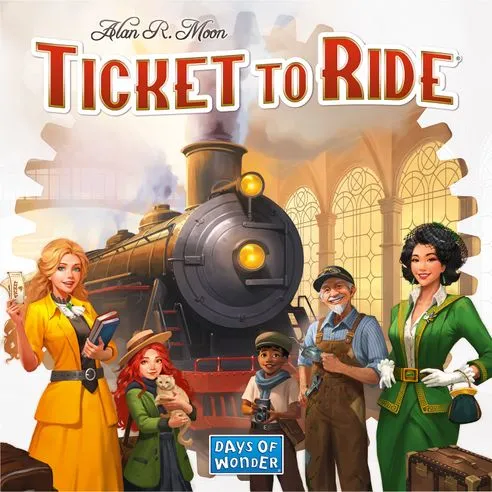
Ticket to Ride
2004 · Alan R. Moon
About as close to a perfect family game as it gets. Three minutes to teach, room for everyone.
Affiliate link — we may earn a commission at no extra cost to you.
/pic8621446.jpg)
Carcassonne
2000 · Klaus-Jürgen Wrede
A quiet, puzzly tile-layer that grows a whole little world on the table in front of you.
Affiliate link — we may earn a commission at no extra cost to you.
Ticket to Ride
- You can teach it in well under five minutes
- Kids and grandparents keep up at the same table
- Tense without ever turning nasty
- Veterans will eventually want something with more bite
- Late-game route blocking can sting a younger player
Carcassonne
- Watching the map grow each turn is quietly satisfying
- Simple enough for a seven-year-old, sharp enough for the adults
- Quick to set up and quick to put away
- A bad run of tiles can pinch your plans
- The scoring takes a game or two before it fully clicks
Ticket to Ride and Carcassonne both sit in our Family list. See the full Family ranking to find where each one lands and what else is worth a spot on your shelf.
How they actually play
Ticket to Ride is built around a single satisfying engine: you collect colored train cards and spend them to claim routes across a map, racing to connect the cities printed on your secret tickets. That is the whole thing, and it is plenty. The magic shows up in the long route, the ambitious coast-to-coast ticket that needs one specific stretch of track nobody else can be allowed to grab first. Quiet players turn surprisingly ruthless over a single length of rail, and that little stab of tension is the moment the game truly has you.
Carcassonne is a softer, more meandering pleasure. You draw and place one tile a turn, a stretch of road or a city wall or a field, then decide whether to drop one of your little wooden meeples to claim it. Slowly a medieval map sprawls across the table, half yours and half theirs. The cunning is all in timing: claim a city too early and someone connects to it and helps themselves to your points; wait too long and they plant their flag first. It is low-conflict scheming, the kind that pairs well with a glass of wine and a good mood, where Ticket to Ride has a sharper, more direct race built into it.
Complexity and learning curve
Both live comfortably in light-medium territory, but Ticket to Ride is the cleaner teach of the two. You can explain it in well under five minutes and everyone immediately understands the goal, which is exactly why it is such a reliable first game for someone who insists they are not a games person. There is very little to misread on your first turn.
Carcassonne is nearly as simple to place tiles, but its scoring is the catch. The way cities, roads, and especially fields pay out takes a game or two before it fully clicks, and a new player can finish their first round not quite sure why someone else just scored big. Neither game will bounce anyone, but if your worry is teaching a nervous beginner, Ticket to Ride asks slightly less of them up front.
Replayability and table presence
Carcassonne has the more quietly satisfying table presence, since the board literally grows in front of you, a new little world every single game, and it is fast to set up and put away. The flip side is variance: a bad run of tiles can pinch your plans, and there is no big dramatic swing or gasp moment to anchor the night. It is a contented game more than an exciting one.
Ticket to Ride holds up through repeat plays on the strength of its ticket draws and the route blocking that gets a little nastier the more experienced your table becomes. Veterans will eventually want something with more bite, and late-game blocking can sting a younger player, but its core job, turning a reluctant person into someone asking for one more round, is something it does about as reliably as anything on the shelf. Carcassonne rewards two players on a slow evening; Ticket to Ride rewards the louder, fuller, mixed-age table.
Buy Ticket to Ride if you want the single best first game for a mixed-age table, something tense but never nasty that a beginner grasps in three minutes and a full group can rally around. Buy Carcassonne if you mostly play with one other person and you love watching a little world grow tile by tile on a slow, contented evening. Ticket to Ride is the louder crowd-pleaser; Carcassonne is the quieter two-player pleasure. Both are excellent starting points if your shelf is still mostly empty.
Ticket to Ride is the crowd-pleasing route race; Carcassonne is the cozy grow-a-map puzzle for two.