Ticket to Ride vs Ticket to Ride: Europe: Which Should You Buy?
If you're shopping for your first big family board game, you've almost certainly landed on these two boxes and blinked. Both are Alan R. Moon designs, released a year apart (2004 and 2005), and they share the exact same engine: collect colored train cards, spend matching sets to claim rail routes between cities, and race to finish secret destination tickets before your trains run out. Both play 2-5 people, both say age 8 and up on the box, and both teach in about five minutes flat. No wonder people agonize over this choice. They look like the same game wearing two different hats.
Here's the difference that actually decides it. The original US map is the pure version, simple and welcoming, the one where kids and grandparents keep up at the same table. Europe takes that same engine and, as its own tagline puts it, quietly grows teeth. Ferries demand wild locomotive cards, tunnels make you gamble on extra card draws, and stations let you borrow an opponent's track when you're boxed in. A little more tension, a little more luck, a little more to sweat over. Which of those sounds like your table is really the whole question.
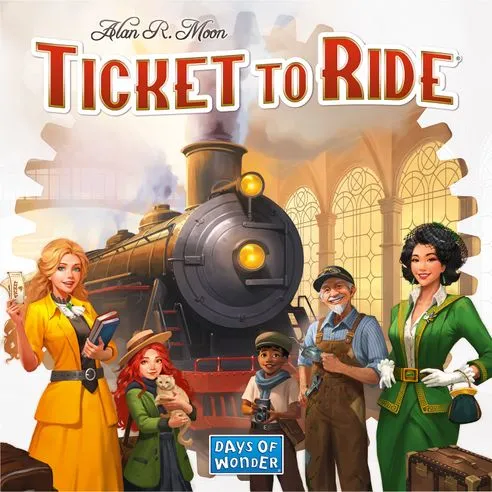
Ticket to Ride
2004 · Alan R. Moon
About as close to a perfect family game as it gets. Three minutes to teach, room for everyone.
Affiliate link — we may earn a commission at no extra cost to you.
/pic9580918.jpg)
Ticket to Ride: Europe
2005 · Alan R. Moon
If you want one box that pulls in your cousin, your kid, and your card-game-curious coworker, this is still the one I reach for. The European tweaks make it the version I'd buy first.
Affiliate link — we may earn a commission at no extra cost to you.
Ticket to Ride
- You can teach it in well under five minutes
- Kids and grandparents keep up at the same table
- Tense without ever turning nasty
- Veterans will eventually want something with more bite
- Late-game route blocking can sting a younger player
Ticket to Ride: Europe
- Teaches in about five minutes, so nobody's lost on turn one
- Tunnels add a genuine push-your-luck gut-check the original lacks
- Stations quietly fix the European map's traffic jams without slowing things down
- A bad tunnel flip can wreck a route through no fault of yours
- Strategies start to rhyme after a handful of plays
Ticket to Ride and Ticket to Ride: Europe both sit in our Family list. See the full Family ranking to find where each one lands and what else is worth a spot on your shelf.
How they actually play
The original Ticket to Ride is beautifully simple. You collect colored train cards and spend them to claim routes across a map of the United States, trying to connect the cities on your secret tickets. That's the whole thing, and honestly, it's plenty. The magic moment is the long route, that ambitious coast-to-coast ticket that hinges on one specific stretch of track nobody else can be allowed to grab first. Quiet players turn surprisingly ruthless over a single length of rail between Seattle and Portland, and that's exactly when the game has you. It's tense without ever turning nasty, which is a rarer combination than it sounds.
Europe runs on the same engine but layers three wrinkles on top. Ferries demand wild locomotive cards before you can cross the water. Tunnels are the big one: you commit to a route, flip three cards off the deck, and pray they don't match a color you need more of. And stations let you borrow an opponent's track in a pinch, which quietly fixes the European map's traffic jams without slowing anything down. Those tunnels are the fun and the frustration in one move. Players genuinely love the tension and also curse it, because a sour flip can stall a plan you spent ten minutes building. If push-your-luck gut-checks sound delicious to you, that's Europe's whole pitch.
Complexity and learning curve
Neither game will scare anyone off. The original teaches in well under five minutes, Europe in about five, and both carry the same light-medium weight. You'll understand either one before the rule sheet hits the table, so nobody's lost on turn one. The real gap shows up in how the first game feels. The US map is clean cause and effect: you drew the cards, you claimed the route, you earned the points. Europe asks new players to also weigh ferries, tunnels, and when to burn a station, which is three extra decisions in a game they're still learning.
There's also the fairness question, and it cuts both ways. In the original, late-game route blocking can sting a younger player who didn't see it coming. In Europe, a bad tunnel flip can wreck a route through no fault of yours at all. So pick your poison: the US version's pain comes from opponents, Europe's comes from the deck. For very young or very cautious tables, I'd lean toward the original, because at least you can see the blocking coming.
Replayability and table presence
Both games eventually show their edges, just different ones. Play the original enough and you'll outgrow it a little. Veterans start wanting something with more bite, and that's fine, because its real job is turning someone who says they're not a games person into someone asking for one more round. Nothing else does that so reliably. Europe holds seasoned players a bit longer thanks to the tunnel gamble, but it has its own ceiling: strategies start to rhyme after a handful of plays, and your openings begin to feel familiar.
Player count matters more than people expect. Europe technically works at two, but it feels roomy and low-conflict, so the map never really bites. The original is happiest with a full mixed-age table where the gentle blocking creates just enough drama. If your usual crew is a couple plus occasional guests, that's worth weighing before you buy. Either way, both wrap in about an hour, so neither will eat your whole evening.
You genuinely can't pick wrong here, but you can pick smarter for your table. Buy the original Ticket to Ride if your group includes kids, grandparents, or true beginners, because it's the easy answer for building a family collection and it stays tense without turning nasty. Buy Europe if your crew already likes a little sweat with their fun, because the tunnels give experienced players something to gamble on and the stations keep the map from clogging up. Plenty of folks point newcomers straight at Europe, and it's one of the best on-ramps to the hobby ever printed, but the gentler US map earns its higher rating with the youngest and most cautious tables. And if you crave deep strategy every single game, be honest with yourself: you'll outgrow both, just not before they've paid for themselves in family nights.
Get the original for the gentlest possible welcome, and get Europe when your table is ready to gamble on a tunnel.