 VS
VS/pic5100691.jpg)
Wingspan vs. Cascadia: Which Should You Buy?
Wingspan and Cascadia are the two prettiest nature games in the gateway-plus space, and they solve very different cravings. Buy Cascadia if you want a calm, quick puzzle that teaches in two minutes and plays in thirty. Buy Wingspan if you want a meatier engine-builder where your choices snowball over an hour into a satisfying combo machine.
Both are excellent. Neither is a mistake. The real question isn't which game is "better," it's which table feel you want, who you're playing with, and how much rules overhead you're willing to carry. Here's how they actually differ once the box is open.
The weight gap is bigger than it looks
On paper these sit close together as gateway-plus games. At the table, they don't feel the same at all. Cascadia is genuinely light. You take one habitat tile, place a matching wildlife token, and pass. That's the whole turn. New players are running it confidently after a single round, and it lands around a 1.8 weight on BGG for a reason.
Wingspan asks more of you. It's a medium-weight, card-driven engine builder (it won the 2019 Kennerspiel des Jahres, the award for the gamer's choice, not the family one). You're juggling food from the birdfeeder dice tower, eggs, card draws, and 150-plus bird powers that chain off each other. The rulebook has more moving parts, and first plays run long while people read their cards. None of that is hard, exactly. But it's a step up, and if your group glazes over at iconography, that step is real.
Table feel: solitaire puzzle vs. growing engine
Cascadia is a quiet, almost meditative tile puzzle. You're drafting from a shared market of tile-and-animal pairs and fitting them into your own little Pacific Northwest, trying to satisfy randomized scoring cards (one game the bears want pairs, the next the hawks want to be loners). It's brainy in a relaxing way. The downside people raise most often is low interaction. Apart from occasionally snatching a tile someone wanted, you're each solving your own grid.
Wingspan feels like building a machine and then watching it run. Early turns are slow and a little underwhelming. By the final round, a single action can cascade through a row of birds, drawing cards, laying eggs, and grabbing food in one satisfying sweep. That arc is the whole appeal. There's a bit more cross-table awareness too, since pink 'when activated' powers can trigger on other players' turns. It's still a low-conflict game, but it breathes differently than Cascadia's calm.
Player count, length, and solo
Cascadia plays 1-4 in about 30-45 minutes and barely slows down as you add people, because turns are so simple. It's a fantastic two-player game and an even better filler or closer for game night. Its solo mode is so well regarded it won the 2023 International Gamers Award for best solo game.
Wingspan plays 1-5 in roughly 40-90 minutes, and it does drag a touch at higher counts since everyone has more to think about. Its solo mode uses an Automa opponent that works well but adds upkeep. If you mostly play two-player or want something that hits the table fast and often, Cascadia has the edge on flow. If you want a centerpiece game that fills an evening, Wingspan earns the time.
Production and shelf appeal
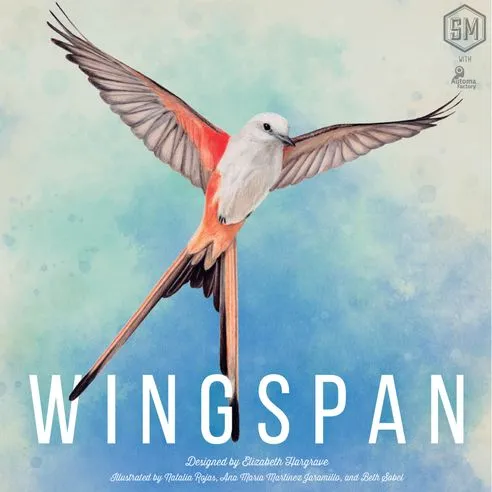
This is close to a tie, and both are stunning. Wingspan's bird art is the showpiece: every card is a unique illustration with a real-world fact, plus the chunky egg minis and the birdfeeder dice tower that everyone wants to use. It's a toy as much as a game.
Cascadia is cleaner and more tactile. The wooden wildlife tokens and hex tiles feel great in hand, and a finished board looks like a tidy little nature mosaic. Wingspan has more wow on the table. Cascadia has less setup, faster teardown, and a smaller footprint, which matters more than people admit when they're deciding what actually gets played.
So which should you buy?
Buy Cascadia if you want a relaxing, quick, easy-to-teach game that works with non-gamers, plays great at two, and shines solo. It's the safer pick for a mixed group and the one more likely to hit the table on a weeknight.
Buy Wingspan if you want more depth, that engine-building payoff, and a showpiece with hundreds of birds to discover over many plays. It rewards repeat play more, and it's the better fit if your group already enjoys games like Splendor or 7 Wonders and wants the next step up.
If you can swing both, they pair beautifully: Cascadia as the warm-up or wind-down, Wingspan as the main event. They scratch different itches, so owning both rarely feels redundant.
Get Cascadia for calm, quick, teach-anyone tile puzzling, and Wingspan for deeper engine-building with a gorgeous bird-filled payoff.
Common questions
Is Wingspan or Cascadia better for beginners?
Cascadia. The turns are dead simple (place a tile, place an animal, pass), and most people are playing confidently within a round. Wingspan is very learnable too, but its bird powers and resource juggling make the first game longer and a bit busier.
Which is the better two-player game?
Both play well at two, but Cascadia has the edge for fast, repeatable two-player sessions because turns are quick and setup is minimal. Wingspan at two is excellent if you want a longer, meatier head-to-head.
Do I really need both?
No, but they overlap less than you'd think. Cascadia is a light, quick puzzle and Wingspan is a medium-weight engine builder. Many people happily own both and use Cascadia as the opener and Wingspan as the main game of the night.